Sunday, March 29, 2009

Kisses unleash chemicals that ease stress levels Rodin's KISS

HICAGO – "Chemistry look what you've done to me," Donna Summer crooned in Science of Love, and so, it seems, she was right. Just in time for Valentine's Day, a panel of scientists examined the mystery of what happens when hearts throb and lips lock. Kissing, it turns out, unleashes chemicals that ease stress hormones in both sexes and encourage bonding in men, though not so much in women.

Chemicals in the saliva may be a way to assess a mate, Wendy Hill, dean of the faculty and a professor of neuroscience at Lafayette College, told a meeting of the American Association for the Advancement of Science on Friday.

In an experiment, Hill explained, pairs of heterosexual college students who kissed for 15 minutes while listening to music experienced significant changes in their levels of the chemicals oxytocin, which affects pair bonding, and cortisol, which is associated with stress. Their blood and saliva levels of the chemicals were compared before and after the kiss.

Both men and women had a decline in cortisol after smooching, an indication their stress levels declined.

For men, oxytocin levels increased, indicating more interest in bonding, while oxytocin levels went down in women. "This was a surprise," Hill said.

In a test group that merely held hands, chemical changes were similar, but much less pronounced, she said.

The experiment was conducted in a student health center, Hill noted. She plans a repeat "in a more romantic setting."

Hill spoke at the session on the Science of Kissing, along with Helen Fisher of Rutgers University and Donald Lateiner of Ohio Wesleyan University.

Fisher noted that more than 90 percent of human societies practice kissing, which she believes has three components — the sex drive, romantic love and attachment.

The sex drive pushes individuals to assess a variety of partners, then romantic love causes them to focus on an individual, she said. Attachment then allows them to tolerate this person long enough to raise a child.

Men tend to think of kissing as a prelude to copulation, Fisher said. She noted that men prefer "sloppy" kisses, in which chemicals including testosterone can be passed on to the women in saliva. Testosterone increases the sex drive in both males and females.

"When you kiss an enormous part of your brain becomes active," she added. Romantic love can last a long time, "if you kiss the right person."

Lateiner, a classical scholar, observed that kissing appears infrequently in Greek and Roman art, but was widely practiced, despite the spread of skin disease at that time by facial kissing. And there was a potential for social faux pas by kissing the wrong person at the wrong time.

Overall, the science of kissing — philematology — is under-researcherd, Hill concluded.

[By RANDOLPH E. SCHMID, AP Science Writer Randolph E. Schmid, Ap Science Writer – Fri Feb 13, 6:22 pm ET]

Eurojust supports wire-tapping of Skype conversations, skype conversations recorded

EUOBSERVER / BRUSSELS – EU's judicial cooperation agency Eurojust will take the lead in finding ways to help police and prosecutors across Europe to wiretap computer-to-computer phone conversations enabled by programs such as Skype.

"We will sit together with all member states to see how this can be done technically and legally," Joannes Thuy, Eurojust spokesman told this website.


The EU wants to eavesdrop internet calls. (Photo: European Commission)


Mr Thuy stressed that the wiretapping would not affect "normal users", but would have to be carried out only as part of a criminal investigation.

Eurojust's talks with prosecutors and police officials from member states, as well as legal experts would be led by Italian prosecutor Carmen Manfreda.

"There are 30 different legal systems all across the EU, so we expect the talks to take several months before first results are presented," Mr Thuy added.

Skype, an Danish-Swedish business developed by Estonian programmers that was sold to E-Bay in 2005 and has over 350 million customers worldwide, is said to be un-spyable by intelligence services.

In its press release, Eurojust says that "Skype has so far refused to share its encryption system with national authorities."

However, Skype claims that it has "extensively debriefed Eurojust on our law enforcement programme and capabilities."

"Skype cooperates with law enforcement where legally and technically possible. Skype remains interested in working with Eurojust despite the fact that they chose not to contact us before issuing this inaccurate report," Brian O'Shaughnessy, head of corporate communications at Skype said in a statement.

The Italian anti-mafia prosecutors requested Eurojust to coordinate this initiative, pointing that criminals in Italy were increasingly making phone calls over the internet in order to avoid getting caught through mobile wiretapping.

Bavarian authorities allegedly also attempted to wiretap Skype conversations and commissioned an IT firm to do this, but were not successful, according to documents obtained by Piraten Party, a movement promoting Internet freedom.

According to Eurojust, customs and tax police in Milan have overheard a suspected cocaine trafficker telling an accomplice to switch to Skype in order to get details of a 2kg drug consignment.

Archeologist Uncovers Evidence Of Ancient Chemical Warfare

Diagram showing the Sasanian Persian mine designed to collapse Dura’s city wall and adjacent tower, the Roman countermine intended to stop them, and the probable location of the inferred Persian smoke-generator thought to have filled the Roman gallery with deadly fumes. The Persians may have used bellows, but a natural chimney effect may also have helped generate the poisonous cloud. (Credit: Image copyright Simon James)


ScienceDaily (Jan. 15, 2009)
— A researcher from the University of Leicester has identified what looks to be the oldest archaeological evidence for chemical warfare -- from Roman times.

At the meeting of the Archaeological Institute of America, University of Leicester archaeologist Simon James presented CSI-style arguments that about twenty Roman soldiers, found in a siege-mine at the city of Dura-Europos, Syria, met their deaths not as a result of sword or spear, but through asphyxiation.

Dura-Europos on the Euphrates was conquered by the Romans who installed a large garrison. Around AD 256, the city was subjected to a ferocious siege by an army from the powerful new Sasanian Persian empire. The dramatic story is told entirely from archaeological remains; no ancient text describes it. Excavations during the 1920s-30s, renewed in recent years, have resulted in spectacular and gruesome discoveries.

The Sasanians used the full range of ancient siege techniques to break into the city, including mining operations to breach the walls. Roman defenders responded with ‘counter-mines’ to thwart the attackers. In one of these narrow, low galleries, a pile of bodies, representing about twenty Roman soldiers still with their arms, was found in the 1930s. While also conducting new fieldwork at the site, James has recently reappraised this coldest of cold-case ‘crime scenes’, in an attempt to understand exactly how these Romans died, and came to be lying where they were found.

Dr James, Reader in the School of Archaeology and Ancient History at the University of Leicester, said: “It is evident that, when mine and countermine met, the Romans lost the ensuing struggle. Careful analysis of the disposition of the corpses shows they had been stacked at the mouth of the countermine by the Persians, using their victims to create a wall of bodies and shields, keeping Roman counterattack at bay while they set fire to the countermine, collapsing it, allowing the Persians to resume sapping the walls. This explains why the bodies were where they were found. But how did they die? For the Persians to kill twenty men in a space less than 2m high or wide, and about 11m long, required superhuman combat powers—or something more insidious.”

Finds from the Roman tunnel revealed that the Persians used bitumen and sulphur crystals to get it burning. These provided the vital clue. When ignited, such materials give off dense clouds of choking gases. “The Persians will have heard the Romans tunnelling,” says James, “and prepared a nasty surprise for them. I think the Sasanians placed braziers and bellows in their gallery, and when the Romans broke through, added the chemicals and pumped choking clouds into the Roman tunnel. The Roman assault party were unconscious in seconds, dead in minutes. Use of such smoke generators in siege-mines is actually mentioned in classical texts, and it is clear from the archaeological evidence at Dura that the Sasanian Persians were as knowledgeable in siege warfare as the Romans; they surely knew of this grim tactic.”

Ironically, this Persian mine failed to bring the walls down, but it is clear that the Sasanians somehow broke into the city. James recently excavated a ‘machine-gun belt’, a row of catapult bolts, ready to use by the wall of the Roman camp inside the city, representing the last stand of the garrison during the final street fighting. The defenders and inhabitants were slaughtered or deported to Persia, the city abandoned forever, leaving its gruesome secrets undisturbed until modern archaeological research began to reveal them.


HR 875 The food police, criminalizing organic farming and the backyard gardener, and violation of the 10th amendment

HR 875 http://thomas.loc.gov/cgi-bin/query/F?c111:1:./temp/~c1112RD9bb:e11439:

This bill is sitting in committee and I am not sure when it is going to hit the floor. One thing I do know is that very few of the Representatives have read it. As usual they will vote on this based on what someone else is saying. Urge your members to read the legislation and ask for opposition to this devastating legislation. Devastating for everyday folks but great for factory farming ops like Monsanto, ADM, Sodexo and Tyson to name a few.

I have no doubt that this legislation was heavily influenced by lobbyists from huge food producers. This legislation is so broad based that technically someone with a little backyard garden could get fined and have their property siezed. It will affect anyone who produces food even if they do not sell but only consume it. It will literally put all independent farmers and food producers out of business due to the huge amounts of money it will take to conform to factory farming methods. If people choose to farm without industry standards such as chemical pesticides and fertilizers they will be subject to a vareity of harassment from this completely new agency that has never before existed. That's right, a whole new government agency is being created just to police food, for our own protection of course.

DO NOT TAKE MY WORD FOR IT, READ THIS LEGISLATION FOR YOURSELF. The more people who read this legislation the more insight we are going to get and be able to share. Post your observations and insights below. Urge your members to read this legislation and to oppose the passage of this legislation.

Pay special attention to

  • Section 3 which is the definitions portion of the bill-read in it's entirety.
  • section 103, 206 and 207- read in it's entirety.

Red flags I found and I am sure there are more...........

  • Legally binds state agriculture depts to enforcing federal guidelines effectively taking away the states power to do anything other than being food police for the federal dept.
  • Effectively criminalizes organic farming but doesn't actually use the word organic.
  • Affects anyone growing food even if they are not selling it but consuming it.
  • Affects anyone producing meat of any kind including the processing wild game for personal consumption.
  • Legislation is so broad based that every aspect of growing or producing food can be made illegal. There are no specifics which is bizarre considering how long the legislation is.
  • Section 103 is almost entirely about the administrative aspect of the legislation. It will allow the appointing of officials from the factory farming corporations and lobbyists and classify them as experts and allow them to determine and interpret the legislation. Who do you think they are going to side with?
  • Section 206 defines what will be considered a food production facility and what will be enforced up all food production facilities. The wording is so broad based that a backyard gardener could be fined and more.
  • Section 207 requires that the state's agriculture dept act as the food police and enforce the federal requirements. This takes away the states power and is in violation of the 10th amendment.
  • There are many more but by the time I got this far in the legislation I was so alarmed that I wanted to bring someone's attention to it. (to the one person who reads my blog)

Didn't Stalin nationalize farming methods that enabled his administration to gain control over the food supply? Didn't Stalin use the food to control the people?

Last word...... Legislate religion and enforce gag orders on ministers on what can and can't be said in the pulpit, instituting regulations forcing people to rely soley on the government, control the money and the food. What is that called? It is on the tip of my tongue..........

I haven't read any of the Senate's version of the bill as I have been poring thru the House's version. Here is the link and I hope some of you can take a look and post your observations and insights below. One thing I am pretty sure of is that very few if any Senator's have actually read the legislation and when it comes up for a vote they will more than likely take someone else's word on how they should vote. The other thing I am pretty sure about is that the legislation was probably written by lobbyists and industry experts.

S 425 http://thomas.loc.gov/cgi-bin/bdquery/z?d111:s425:

Things you can do

  1. Contact your members at 202-224-3121 and ask them to oppose HR 875 and S 425. While you are at it ask them if they personally have read the legislation and what their position is? If they have not read the legislation ask them to read it and politely let them know that just because other representitives are not reading the legislation and voting on it does not mean they can do the same.
  2. Get in touch with local farmers and food producers by attending a local farmers market and asking them how business is.
  3. Attend a local WAPF meeting, this is a good start to learning about what is going on in farming and local & state initiatives . The website is http://www.westonaprice.org/localchapters/index.html
  4. Check out the Farmers Legal Defense Fund at http://www.ftcldf.org/index.html
  5. Find out who sits on your states agriculture and farming committee and contact them with your concerns.
  6. Continue to contact your elected officials and let them know your position on legislation and why.
  7. Get active at the local and state levels, this is the quickest way to initiate change.

The Obama Deception (Video)


The Obama Deception is a hard-hitting film that completely destroys the myth that Barack Obama is working for the best interests of the American people. The Obama phenomenon is a hoax carefully crafted by the captains of the New World Order. He is being pushed as savior in an attempt to con the American people into accepting global slavery.

President Obama, Why Did You Pay Blackwater $70 Million in February?


Obama may keep the company on the government payroll months after its Iraq contract expires. Not bad for a firm supposedly going down in flames.

For those already outraged at the AIG bonus scandal, here is a fact that should add more fuel to the fire: The Obama administration has paid the mercenary firm formerly known as Blackwater nearly $70 million to operate in Iraq and, according to The Washington Times, may keep the company on the payroll months past the official expiration of its Iraq contract in May. I reviewed Blackwater's recent transactions with the Obama State Department and discovered a $45 million payment to Blackwater on February 4, 2009 for "protective services-Iraq." It is described as a "funding action only." Here is the interesting part: The estimated "Ultimate Completion Date" is 5/07/2011.

The Washington Times (as described below) reported on a $22 million payment to Blackwater on February 2. Combined with the $45 million payment I discovered, that's nearly $67 million in 72 hours. Not bad for a company supposedly going down in flames.

With the U.S. economy in shambles and millions of Americans struggling to make ends meet and keep their homes, Obama and Secretary of State Hillary Clinton need to explain to U.S. taxpayers how they justify these mega-payments to a scandal-plagued mercenary company. (At the very least, someone should ask Robert Gibbs about it).

It has been widely reported that the Bush administration's preferred mercenary company, which recently renamed itself Xe, will soon be leaving Iraq. That news came early this year after the State Department, under immense public pressure, announced it would not renew the company's lucrative deal to act as the private paramilitary force for senior U.S. occupation officials. The Iraqi government has said it wants the company to leave Iraq and says it has revoked the company's operating license. The Obama administration continues to use Blackwater in Afghanistan and the company has extensive domestic training contracts with the military and law enforcement agencies inside the borders of the U.S.

Earlier this week, The Washington Post reported that some of Blackwater's armed operatives may simply be rehired by two other US mercenary firms that are expected to take over Blackwater's work in Iraq under the Obama administration: Triple Canopy and DynCorp. Now, The Washington Times reports that the State Department has signed contracts with Blackwater that appear to extend the company's presence in Iraq at least until September 2009.

According to the paper:

"On Feb. 2, a department spokesman was asked whether officials planned to renew one of Blackwater's contracts past May. The spokesman, Robert Wood, said the department had told Blackwater 'we did not plan to renew the company's existing task force orders for protective security details in Iraq.'

"But records available through a federal procurement database show that on that same day, the State Department approved a $22.2 million contract modification for Blackwater 'security personnel' in Iraq, with a job completion date of Sept. 3, 2009."

"Why would you continue to use Blackwater when the Iraqi government has banned the highly controversial company and there are other choices?" said Melanie Sloan, executive director of the nonpartisan Citizens for Responsibility and Ethics in Washington.

State Department spokesman Noel Clay told The Washington Times the contract modification involves aviation services. "The place of performance is Iraq, but it is totally different than the Baghdad one that expires in May," he said. Sloan called the State Department's explanation of the Feb. 2 deal a "parsing of words" and said "they should just be straight with us." Xe spokeswoman Anne Tyrell declined to comment on the status of the company's work in Iraq or the Feb. 2 contract modification. She said the company was aware that the State Department had indicated that it did not plan to renew its contracts in Iraq but that Xe officials had not received specific information about leaving the country. "We're following their direction," she said.


Blackwater recently renamed itself Xe and its owner Erik Prince "resigned" as CEO, though he remains its sole owner and chairman.

UPDATE: Could Arlen Specter's Logic on AIG Bonuses Be Applied to Blackwater?

Several people have written me asking what the Obama administration should do with Blackwater, following reports that the State Department paid the company some $70 million over a 72 hour period in February.

Many people take the position that Obama is dealing with remnants of the Bush administration's disastrous policies and that it will take time to unravel. Fair enough. But, with the U.S. economy in shambles, is it really a priority to make good on payments to a company like Blackwater?

I have long written that the Obama Iraq policy will necessitate using mercenary forces. This is true for a number of reasons, not the least of which is Obama's refusal to scrap that monstrous U.S. fortress they are calling an embassy. If it's not going to be Blackwater guarding Obama's occupation officials, it will be Triple Canopy and DynCorp (who will in turn hire a bunch of the "fired" Blackwater guys anyway). The point here is this: I disagree that the reality is simply that Obama needs time to phase out Blackwater and his hands are tied when it comes to paying them on existing contracts. I believe Obama needs them to sustain his bad Iraq policy, which will continue the occupation, albeit with a softer face. If Obama wanted to, he could outright fire Blackwater. Henry Waxman and others have called for that. He certainly would have the support of the American people, particularly given how much money Blackwater has milked from the U.S. treasury.

All of this brings me to Republican Sen. Arlen Specter, former chair of the Judiciary Committee. Yesterday, he was interviewed on MSNBC by Andrea Mitchell about the AIG bonuses. Read what he says about the AIG contracts not having to be honored and then apply the logic to Obama's Blackwater situation:

Mitchell: What say you when it comes to these bonuses? Should they be taxed back? Should the AIG executives who approved the bonuses have to commit hari-kari? With whom do you side?

Specter: Andrea, they're not enforceable under the law. They are against public policy. It is obviously against public policy to pay bonuses to people who caused the problem. If you have, for example, a contract for the sale of heroin, that's not enforceable. You take those cases to court, they won't be enforced. It's just that plain. It's set out very simply in the restatement of the law on contracts

(.....)

Mitchell: Well, you know, there's been a lot ventilating on all sides, but you're a former district attorney, a former prosecutor, experienced lawyer and we tend to trust your judgment on this, former Judiciary Chairman. So let me hear you out on when you say they're not enforceable, the top economic adviser and the Treasury Secretary said that these were contracts that if the government broke the contracts, there would be greater expense in going to court and suing to get the money back.

What would the next steps be in a practical way to get the money back and break the contracts?

Specter: The top economic adviser and the Secretary of the Treasury are wrong again. It happens too often to be excusable. I'd like to argue this as a legal matter. If you have a contract, which is against public policy, it is not enforceable. I gave you an extreme example. If you have a contract for the delivery of heroin, the use of heroin, the delivery of heroin is against the law, you can't enforce it.

Let those individuals who claim that they're entitled to bonuses go to court and the government will defend the case and will say these are against public policy. How can you pay a bonus to this individual in this company, which raised the problem and caused this $180 billion bailout and now they want bonuses on top? It is simply unenforceable.

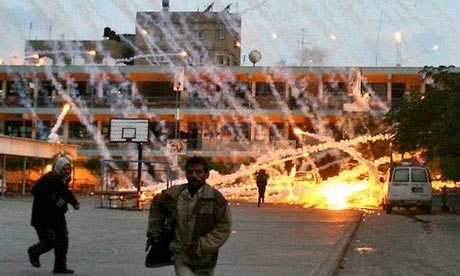
Israel accused of indiscriminate phosphorus use in Gaza


Human Rights Watch report claims Israel committed war crimes in its use of air-burst white phosphorus artillery shells

Israel's military fired white phosphorus over crowded areas of Gaza repeatedly and indiscriminately in its three-week war, killing and injuring civilians and committing war crimes, Human Rights Watch said today.

In a 71-page report, the rights group said the repeated use of air-burst white phosphorus artillery shells in populated areas of Gaza was not incidental or accidental, but revealed "a pattern or policy of conduct".

It said the Israeli military used white phosphorus in a "deliberate or reckless" way. The report says:

• Israel was aware of the dangers of white phosphorus.

• It chose not to use alternative and less dangerous smoke shells.

• In one case, Israel even ignored repeated warnings from UN staff before hitting the main UN compound in Gaza with white phosphorus shells on 15 January.

'They say Israel used white phosphorus in a way that killed civilians': Rory McCarthy on the Human Rights Watch report Link to this audio

"In Gaza, the Israeli military didn't just use white phosphorus in open areas as a screen for its troops," said Fred Abrahams, a senior Human Rights Watch researcher. "It fired white phosphorus repeatedly over densely populated areas, even when its troops weren't in the area and safe smoke shells were available. As a result, civilians needlessly suffered and died." He said senior commanders should be held to account.

Human Rights Watch called on the UN secretary-general, Ban Ki-moon, to launch an international commission of inquiry to investigate allegations of violations of international law in the Gaza war by the Israeli military and Hamas, the Palestinian Islamist movement that controls Gaza.

The Israeli military has defended its conduct in Gaza in the face of mounting allegations of serious violations of international law and said its soldiers did not intentionally target civilians. When Israel's use of white phosphorus emerged during the war, the military at first denied using the weapon, then said it only used weapons in accordance with international law. Later it announced an internal inquiry, led by a colonel, would be held.

Tonight the Israeli military said its investigation into the use of white phosphorous was still under way, but insisted its use of what it called 155mm "smoke shells" was legal.

"Based on the findings at this stage it is already possible to conclude that the IDF's use of smoke shells was in accordance with international law," it said. "These shells were used for specific operational needs only and in accord with international humanitarian law. The claim that smoke shells were used indiscriminately, or to threaten the civilian population, is baseless."

White phosphorus burns in contact with oxygen and causes deep burns when it touches human skin, sometimes reaching to the bone. The weapon is not illegal itself and can be used to provide a smokescreen on the battlefield or as an incendiary weapon against a military target. However, its use is regulated even by customary international law. It must be used in a way that distinguishes between combatants and civilians and cannot be used to target civilians.

Most of the Israeli military's white phosphorus in Gaza was fired in 155mm artillery shells, each containing 116 wedges soaked with the chemical.

In January, the Guardian found one such shell still smoking several days after it was fired, outside the home of the Abu Halima family in Atatra. One white phosphorous shell hit the house directly, killing a father and four of his children. His wife was severely burnt. Human Rights Watch also reported the same case.

Human Rights Watch found 24 spent white phosphorus shells in Gaza, all from the same batch made in a US ammunition factory in 1989 by Thiokol Aerospace. Other shells were photographed during the war with markings showing they were made in the Pine Bluff Arsenal, also in America, in 1991.

Human Rights Watch said the Israeli military often used the weapon even in areas where there were no Israeli troops on the ground, which it said, "strongly suggests that the IDF [Israel Defence Forces] was not using the munition for its obscurant qualities but rather for its incendiary effect".

The group said it found no evidence that Hamas fighters used Palestinian civilians as human shields - a key Israeli claim - in the area at the time of the attacks it researched.

The rights group studied six cases in detail in which 12 civilians were killed and dozens more were injured.

In one case, witnesses described how a white phosphorus shell hit a car in Tel al-Hawa, in south-eastern Gaza City, killing a bank manager, his wife and two of their children on 15 January.

On the same day, at about 7.30am, Israeli artillery shells began falling near the main compound of the UN Relief and Works Agency in Gaza City, where 700 civilians were sheltering. UN staff made repeated telephone calls to the Israeli military asking them to stop but, at about 10am, six shells hit the compound, three of which contained white phosphorus. The warehouse was hit, causing at least $10m of damage, and it continued to burn for 12 days.

The Israeli prime minister, Ehud Olmert, said at the time that "Hamas fired from the UNRWA site". But the UN has always denied there were any militants in the compound or firing from the compound.

In another case, on 17 January, an artillery shell that had already discharged its white phosphorus hit a UN school in Beit Lahiya, where 1,600 civilians were sheltering. It killed two brothers in a classroom and severely injured their mother and cousin.